






Choosing a label material is not only a visual decision. The face stock, adhesive, liner, printing method and surface finish must work together with the container, filling process, storage conditions and application equipment. A material that performs well on a dry cardboard box may fail on a chilled bottle, an oily cosmetic jar or a flexible container.
This guide compares four widely used label and sticker materials—paper, BOPP, PET and vinyl—and explains how packaging teams can select a practical construction for product labels. It is written for brand owners, contract manufacturers, packaging buyers and engineers preparing a custom label specification.
Quick Comparison: Paper, BOPP, PET and Vinyl Labels
| Material | Best For | Main Strengths | Important Limitations |
|---|---|---|---|
| Paper | Dry indoor products, boxes, jars and short-life promotions | Natural appearance, broad print compatibility, economical for many applications | Lower resistance to water, oil, abrasion and tearing unless protected |
| BOPP / PP Film | Beverages, food, cosmetics, household products and clear-label applications | Moisture resistance, flexible film, white or clear options, good shelf appearance | Requires correct ink, coating and adhesive selection for the application |
| PET Film | Durable goods, electronics, chemicals, security and demanding industrial labels | High strength, dimensional stability, heat and abrasion resistance | Usually higher cost and less conformable than thin PP films |
| Vinyl | Outdoor graphics, equipment labels, vehicle stickers and promotional die-cut stickers | Flexible and conformable; suitable constructions can support durable outdoor graphics | Outdoor life depends on the ink, laminate, adhesive, surface preparation and exposure conditions; test the complete construction |
The table is a starting point. Final performance depends on the complete label construction and the real packaging environment. Test samples on the production container whenever adhesion or durability is critical.
1. Paper Label Materials
Paper is commonly selected when cost, print quality and a natural tactile appearance are priorities. Coated paper produces smooth color reproduction for retail graphics, while uncoated and textured papers can support a craft, premium or sustainable-looking presentation.
Common paper options
- Coated paper: smooth surface for detailed graphics, fine text and full-color printing.
- Uncoated paper: more natural texture and writable surface, depending on the coating and ink system.
- Kraft paper: brown or natural appearance for food, personal-care and craft-style packaging.
- Metallized paper: reflective appearance for decorative labels and selected promotional applications.
When paper works well
Paper labels are a strong choice for dry indoor products, cartons, glass jars, wine and specialty food packaging, promotional stickers and products with a controlled supply chain. Lamination or varnish can improve scuff and moisture resistance, but it does not turn every paper construction into a long-term waterproof label.
Questions to check before selecting paper
- Will the package be refrigerated, placed in an ice bucket or exposed to condensation?
- Can oil, alcohol, detergent or cosmetic ingredients contact the label?
- Will the label be rubbed during packing, shipping or consumer use?
- Is recyclability or a natural paper appearance more important than long-term durability?
2. BOPP and Polypropylene Film Labels
BOPP is a polypropylene film widely used for product labels that need better moisture resistance and durability than standard paper. It is available in white, clear, transparent and metallized constructions. Because the film does not absorb water like untreated paper, it is often used on beverage, food, cosmetic, personal-care and household-product containers.
White BOPP
White BOPP provides an opaque background for strong color reproduction. It is useful when the container color or product contents should not affect the artwork. A gloss or matte finish can be added according to the desired shelf appearance.
Clear BOPP
Clear BOPP can create a no-label look on transparent glass or plastic. Successful clear labels require attention to adhesive clarity, container cleanliness, application pressure and the possibility of bubbles or hazing. White ink may be printed beneath selected artwork areas so colors remain visible against the product.
Metallized BOPP
Metallized film creates a reflective base that can be combined with opaque white and colored inks. It is useful for decorative effects without applying foil to every metallic area. Artwork should clearly identify which areas are metallic, white-backed or transparent.
Where BOPP needs careful testing
Film material alone does not guarantee performance. Adhesive must match the surface energy and shape of the container. Very small diameters, squeezable containers, textured surfaces and contamination from oil or powder can create lifting edges. The converter should know the container material, minimum application temperature and service environment before production.
3. PET Label Materials
PET film is selected for applications requiring higher strength, dimensional stability and resistance to heat, chemicals or abrasion. Common uses include electronics, tools, durable equipment, industrial components, warning labels, asset identification and selected security labels.
Advantages of PET
- High tensile strength and resistance to tearing
- Good dimensional stability for precise graphics and variable information
- Compatibility with durable laminates and protective coatings
- White, clear, silver and specialty appearances
- Suitable for demanding barcode, serial number and identification applications
Limitations to consider
PET is typically stiffer and more expensive than common PP label films. On tightly curved or squeezable packages, a thinner and more conformable film may perform better. Chemical resistance also depends on the topcoat, ink, ribbon, adhesive and overlaminate—not only the PET face stock.
4. Vinyl Labels and Die-Cut Stickers
Vinyl is flexible and durable, making it useful for outdoor graphics, equipment labels, vehicle stickers and promotional applications. It is particularly suitable for individually cut shapes where the printed piece and backing follow the design outline.
For stickers supplied as separate pieces, review our die-cut sticker solutions. For multiple labels arranged on flat sheets, see our custom sheet labels. Outdoor life still depends on the ink, laminate, adhesive, surface preparation and exposure conditions.
Adhesive Selection Matters as Much as the Face Stock
A correct face stock can still fail when paired with the wrong adhesive. The main variables are the container surface, curvature, application temperature, storage temperature and required removability.
| Adhesive Type | Typical Use | Key Check |
|---|---|---|
| Permanent acrylic | General product packaging and long-term identification | Confirm adhesion on the actual plastic, glass, metal or paper surface |
| Removable | Temporary information, promotions and selected reusable containers | Test removal time, temperature and possible residue |
| Freezer / low-temperature | Cold filling, refrigeration and frozen products | Separate application temperature from later service temperature |
| High-tack | Textured, difficult or lower-surface-energy containers | Check edge lift, repositioning needs and application pressure |
| Specialty chemical-resistant | Industrial, laboratory and selected household applications | Define the chemical, concentration, contact time and temperature |
Container and Application Questions to Answer
Before requesting a quotation, collect the following information. These details allow a label manufacturer to recommend a more reliable construction and reduce the need for repeated sampling.
- Container material: glass, HDPE, LDPE, PET, PP, metal, coated paperboard or another surface.
- Surface shape: flat, cylindrical, tapered, small diameter, textured or squeezable.
- Label size: finished width and height, including corner radius or custom die-cut shape.
- Application method: hand application or automatic labeling machine.
- Application conditions: clean and dry surface, cold filling, condensation, oil, dust or powder.
- Service conditions: indoor, outdoor, refrigerated, frozen, humid, chemical contact or abrasion.
- Required life: temporary promotion, normal product shelf life or durable multi-year identification.
- Roll specification: core size, maximum outside diameter, winding direction and labels per roll.
Printing, Lamination and Finishing
Material selection must be coordinated with artwork and finishing. Full-color CMYK, Pantone spot colors, white ink, metallic effects, foil, spot UV and variable data each affect the production route. Small text, barcodes and nutrition panels should be reviewed at final size rather than only on a large monitor.
A laminate provides stronger physical protection than an unprotected print surface in many applications. Varnish can offer a lighter protective finish when the service environment is less demanding. Matte finishes reduce glare but may change color appearance; gloss finishes can increase contrast and saturation. For metallic or clear materials, a white-ink layer should be defined in the artwork.
Labels for Automatic Application
Automatic labeling requires more than the correct label size. The liner, die-cutting accuracy, matrix removal, label gap, roll tension, core and winding direction must match the machine. Share a labeler diagram or a sample roll whenever possible. A short production trial is especially valuable for high-speed lines, small containers and transparent films.
How to Run a Useful Label Test
- Apply samples to production containers, not only laboratory panels.
- Clean and prepare the surface in the same way used on the filling line.
- Apply at the expected line temperature and pressure.
- Allow the adhesive to build according to the supplier’s recommended dwell time.
- Expose the package to actual refrigeration, humidity, abrasion or chemical conditions.
- Check edge lift, bubbles, wrinkles, print scuffing, barcode readability and removal behavior.
A short test cannot reproduce every long-term condition, but it can identify obvious mismatches before a full production run.
Material Selection Examples
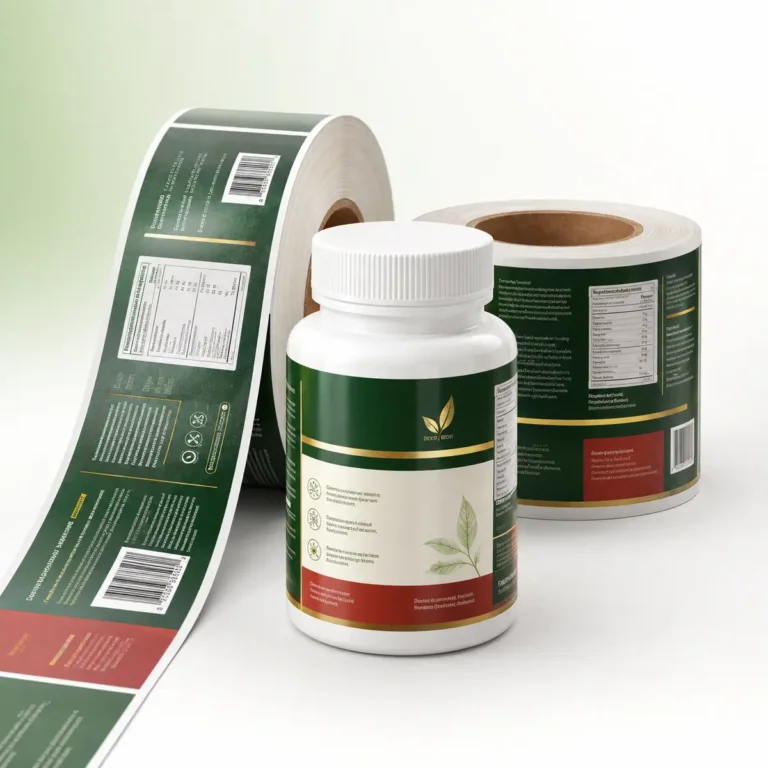
- Dry supplement bottle: coated paper may be suitable for an economical label; white BOPP offers additional moisture and handling resistance.
- Chilled beverage: white or clear BOPP with an adhesive selected for condensation and application temperature is usually a better starting point than standard paper.
- Cosmetic jar: BOPP can resist bathroom humidity, while adhesive testing should include curved surfaces and possible oil contact.
- Industrial equipment: PET with a durable print system and protective laminate may be appropriate when heat, chemicals or abrasion are expected.
- Premium natural product: textured or kraft paper can support the desired appearance if the environment is dry and abrasion is controlled.
Frequently Asked Questions
Are BOPP labels waterproof?
The BOPP face stock is moisture resistant, but total label performance depends on the adhesive, ink, coating, edges and application surface. The finished construction should be tested under the real conditions.
Is PET always better than BOPP?
No. PET offers higher strength and stability, but BOPP may be more conformable and economical for common bottles and flexible packaging. The best material is the one that meets the required performance without unnecessary cost.
Can paper labels be laminated?
Yes. Gloss or matte lamination can improve scuff and moisture resistance. Exposed paper edges and the adhesive still need to be considered in wet or refrigerated applications.
What information is needed for an accurate quote?
Provide label size, quantity, number of designs, container material and diameter, preferred face stock, adhesive requirement, finish, application method, roll direction, core size and artwork. Photos or empty container samples can help when the surface is unusual.
Supplement Bottles and Jars
Vitamin, gummy, capsule, collagen and nutraceutical containers often need a material and adhesive matched to the bottle surface, storage conditions and application method. See our custom supplement labels for bottles and jars, then use the supplement label printing guide to confirm artwork, finishing and roll specifications.
Request a Material Recommendation
SZKAYU manufactures custom printed labels, roll labels, sheet labels and security and holographic labels for B2B packaging projects.
Send the container details, label size, quantity, artwork and application conditions through our quotation form. We can review the specification and recommend a paper, BOPP, PET or vinyl label construction for sampling and production.