







Supplement label printing requires more than attractive graphics. The label must fit the bottle or jar, remain readable through storage and handling, work with the selected application method, and reproduce approved artwork consistently across the production run. This guide explains the main decisions buyers should confirm before ordering custom vitamin, gummy, capsule, collagen, herbal or nutraceutical labels.
If you already have artwork and container dimensions, visit our Custom Supplement Labels page for manufacturing options and a project quotation.
1. Start with the Container and Application Method
Label construction should be selected around the actual container rather than appearance alone. Confirm whether the packaging is a round bottle, wide jar, tapered container or a front-and-back label set. Plastic and glass surfaces may need different adhesives, while small-radius containers require materials that resist edge lifting.
The application method is equally important. Hand-applied labels allow more flexibility, but automatic labeling lines require accurate roll direction, core size, outside diameter, label gap and web width. Supplying these details before production helps prevent line stoppages and avoids rewinding finished rolls.
2. Choosing a Supplement Label Material
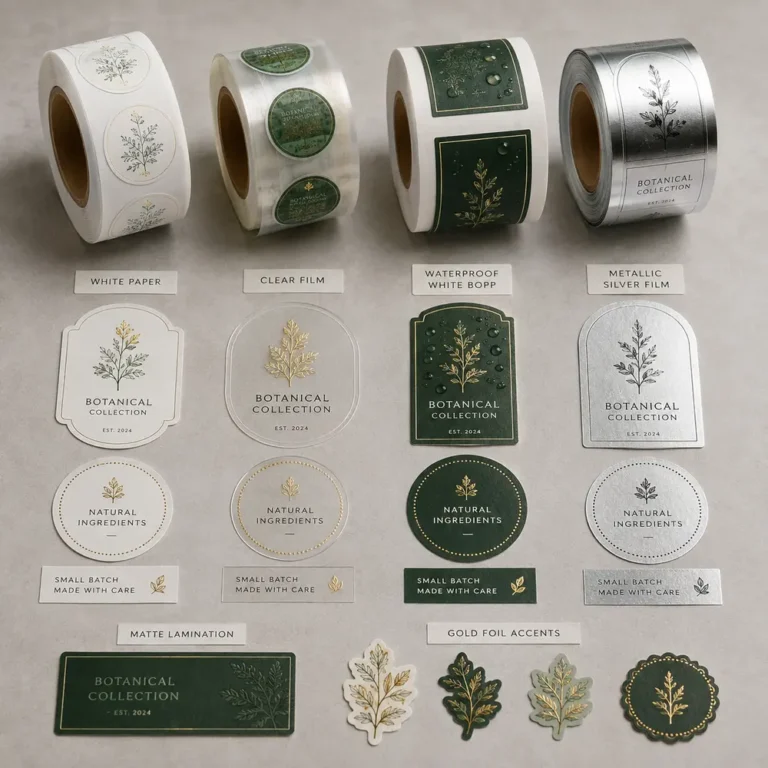
The best material depends on storage conditions, container surface, desired finish and budget. The following comparison is a practical starting point:
| Material | Typical Advantages | Suitable Applications |
|---|---|---|
| Coated paper | Cost-effective, good print quality, wide finish selection | Dry indoor products and standard vitamin bottles |
| White BOPP / PP film | Moisture resistance, durability and clean white appearance | Gummy jars, supplements handled frequently and humid environments |
| Clear BOPP film | Transparent “no-label” appearance | Clear bottles and designs that show the container or product |
| PET film | High dimensional stability and resistance to handling | Premium, technical or demanding packaging applications |
| Metallic film or foil-effect stock | Reflective shelf impact without covering the whole design in foil | Premium supplements, beauty nutrition and limited editions |
For a deeper material comparison, see our label material selection guide.
3. Adhesive Selection and Container Testing
A permanent general-purpose adhesive is suitable for many smooth bottles, but it should not be assumed to work on every surface. Low-surface-energy plastics, textured containers, small diameters, cold storage and oily environments can change adhesion performance.
Before mass production, test the proposed label construction on the actual filled container. Apply samples under normal production conditions and check initial tack, edge lifting, wrinkles and adhesion after the expected storage period. If the container is refrigerated or exposed to moisture, the test should reproduce those conditions.
4. Printing and Premium Finishes
Full-color CMYK printing is suitable for photography, gradients and detailed brand graphics. Pantone spot colors can be specified when a critical brand color needs closer control. A physical or approved digital proof should define expectations before production.
Common finishing options include gloss or matte lamination, protective varnish, hot foil, metallic effects, spot UV, embossing and textured finishes. Lamination can improve scuff and moisture resistance, while selective decorative effects can highlight a logo or product name without making the complete label overly reflective.
When comparing finishes, consider both shelf appearance and downstream performance. Thick decorative layers, heavy embossing or large foil areas should be reviewed against the label shape, winding tension and application equipment.
5. Artwork, Dieline and Readability Checks
Final artwork should match the approved label dimensions and include the required bleed and safe area. Keep small text, barcodes and essential information away from the die-cut edge, overlap area and container curve. Text size, line weight and contrast should remain readable after printing at final size.
Before approval, verify:
- Finished label width, height, shape and corner radius
- Bleed, safe area and overlap allowance
- Barcode and QR code size, contrast and quiet zones
- Space for lot number, batch code or expiry-date printing
- Color references and any Pantone requirements
- Correct version of ingredients, directions, warnings and other required text
Regulatory content varies by destination market and product category. The buyer should provide and approve compliant final text; the printer reproduces the approved artwork and can assist with printability, layout and material recommendations.
6. Roll Specifications for Automatic Labeling
For roll-supplied labels, “labels on a roll” is not a complete production specification. Share the labeling machine requirements or a reference roll whenever possible. The following items should be confirmed:
- Core inside diameter
- Maximum roll outside diameter
- Labels per roll or maximum roll weight
- Web width and label-to-label gap
- Winding direction and label orientation
- Inside or outside wound construction
- Splice and roll-end requirements
Our Roll Labels section provides related information for automatic and manual label application.
7. Variable Data, Barcodes and Date Coding
Supplement packaging may require barcodes, QR codes, sequential information or an unprinted area for downstream batch and expiry-date coding. Confirm whether variable data is printed during label production or added later on the packaging line.
Barcode and QR samples should be scanned from production proofs and finished labels. For later date coding, test the intended ribbon, inkjet or laser process on the selected laminate or varnish because highly glossy surfaces may require a designated printable area.
8. Pre-Production Validation and Quality Control
A disciplined approval process reduces expensive errors. Recommended checkpoints include dieline confirmation, artwork version control, color approval, material and adhesive confirmation, barcode scanning, roll-direction verification and inspection of die-cutting and matrix removal.
During production, buyers may specify checks for print registration, color consistency, text clarity, label dimensions, winding quality, roll quantity and packaging identification. Retaining an approved reference sample helps align repeat orders.
9. Information to Send for an Accurate Quote
Prepare the following information before requesting pricing:
- Label dimensions and shape
- Total quantity and number of artwork versions
- Container material, shape and diameter
- Paper, BOPP, PET or preferred appearance
- Required adhesive and storage environment
- Printing colors and finishing processes
- Roll core, outside diameter and winding direction
- Application method and labeling-machine requirements
- Artwork file or representative design
- Destination country and delivery requirements
Frequently Asked Questions
Are BOPP labels suitable for supplement bottles?
White or clear BOPP is commonly selected when moisture resistance, durability and a clean film appearance are important. Adhesive performance should still be tested on the actual bottle.
Can supplement labels be supplied for automatic application?
Yes. Labels can be produced with custom core size, roll diameter, web width, gap and unwind direction to match compatible labeling equipment.
Can multiple supplement flavors or formulas be combined in one order?
Multiple artwork versions may be planned together when size, material and finishing specifications are compatible. Provide the quantity for each version so production and pricing can be evaluated accurately.
Who is responsible for regulatory label content?
The buyer should provide and approve all market-specific ingredients, facts panels, warnings and other required content. SZKAYU supports print layout, material selection and production according to the approved artwork.
Discuss Your Supplement Label Project
Send your bottle dimensions, label size, quantity, material preference, roll requirements and artwork. We can review printability and recommend a suitable construction for your project.
Request a supplement label printing quote or review our custom supplement label manufacturing options.